Posted on

American Places Tell American Stories

Navy Liberty Forge Built graphic reading "American places tell American stories." above the anvil badge logo, with the line "Heritage is something you can still go find."

Not every American story happened on a battlefield with a name everyone knows.

Some of them happened in a small stone mill by a river. Some happened on an island in a bay, behind a locked gate, far from the mainland. Some happened in a courtroom, or a firehouse, or a swamp crossing that most maps do not even bother to mark. These places are still there. Most of them are still open. Almost all of them get a fraction of the attention they deserve.

As the country moves toward America 250, it is worth slowing down and asking a different question than the usual one. Not just what happened on July 4, 1776, but what happened in the hundreds of other places that built the country before and after that date. Here are five of them, chosen for range rather than fame, that are worth knowing and worth visiting.

Slater Mill, Pawtucket, Rhode Island

Slater Mill is a small brick building on the Blackstone River, and it is where American manufacturing effectively began. In 1793, Samuel Slater built the first water-powered cotton spinning mill in the country, using Arkwright-style machinery he had learned in England and rebuilt from memory. The site is often described as the birthplace of the American Industrial Revolution, because it marks the shift from goods made by hand in homes to goods made by machines in factories, along with everything that followed from that shift: hourly wages, mill towns, and eventually organized labor.

The mill still stands and is open to visitors, with guided tours and a visitor center that runs on a seasonal schedule. It is not a large site. It does not need to be. Standing in the room where American industry started tells you more in ten minutes than most textbook chapters do.

Angel Island Immigration Station, San Francisco Bay, California

Most Americans know the story of Ellis Island. Fewer know Angel Island, which processed immigrants on the West Coast from 1910 until the station’s administration building burned in 1940. The two sites tell very different stories. Ellis Island is remembered largely as a gateway. Angel Island was built to detain and screen, particularly under the Chinese Exclusion Act, and many of the immigrants held there, mostly from China and other parts of Asia, faced lengthy interrogation, medical inspection, and sometimes months of confinement before they were allowed to land or were turned away.

The site matters because it shows a side of American immigration history that does not fit neatly into a single narrative. It is a story of exclusion and of resilience at the same time, including poetry that detained immigrants carved into the barrack walls, some of which survives today. The restored buildings, including a museum housed in the old hospital, are open to the public on the island, reachable by ferry from the Bay Area.

The Old Courthouse, St. Louis, Missouri

A courthouse does not look like a dramatic historic site from the outside, and that is part of what makes the Old Courthouse in St. Louis worth knowing. More than 300 freedom suits were filed there by enslaved people seeking their liberty through the courts, and the most consequential was filed in 1847 by Dred and Harriet Scott. Their case worked its way to the Supreme Court, which ruled that enslaved people had no standing to sue. The decision did not settle the argument over slavery. It intensified it, and it is now understood as one of the events that hastened the Civil War.

The building is preserved as part of the National Park Service’s Underground Railroad Network to Freedom and remains open to visitors, with exhibits, ranger staff, and public access built into what is otherwise still a working piece of downtown St. Louis architecture. Few places make the connection between law, justice, and history as directly as a courtroom where real freedom was argued for and denied.

Fireman’s Hall Museum, Philadelphia, Pennsylvania

Long before city fire departments existed, ordinary citizens organized to protect each other’s homes and shops. In 1736, Benjamin Franklin founded the Union Fire Company in Philadelphia, one of the first volunteer fire companies in the colonies, built on the simple idea that neighbors owed each other a bucket brigade when disaster struck. That tradition of volunteer service is now told inside Fireman’s Hall Museum, housed in a restored firehouse built around the turn of the twentieth century in Philadelphia’s Old City.

The museum traces the evolution of firefighting from hand pumps and leather buckets to modern apparatus, and it does so inside a building that was itself a working firehouse. It is free to visit, open Tuesday through Saturday, and sits just a short walk from Elfreth’s Alley. For anyone connected to the fire service, current or retired, it is a direct line back to the origin of the trade.

Moores Creek National Battlefield, Currie, North Carolina

Not every Revolutionary War battle looks like Lexington or Yorktown. On February 27, 1776, Patriot militia met a larger Loyalist force at a bridge crossing over Moores Creek, roughly twenty miles from Wilmington. The Patriots had quietly removed the bridge planking and greased the rails the night before. The fight that followed lasted only a few minutes, but it was one of the first decisive Patriot victories of the war, and it helped push North Carolina to become the first colony to instruct its delegates to the Continental Congress to vote for independence.

The battlefield is preserved today as an 87-acre National Park Service site, open daily, with a walking trail that follows the ground where the fight actually happened. It rarely draws the crowds that larger Revolutionary sites do. The history it holds is no smaller for that.

Carrying the Story Forward

None of these five places require a plane ticket to a famous city or a spot on a postcard rack. A mill, an island, a courthouse, a firehouse, a creek crossing. Ordinary places, extraordinary weight.

That is closer to how American history actually happened than any single monument can show. It happened in workshops and courtrooms and small towns, carried forward by people who were rarely thinking about how they would be remembered. As we discussed in America 250 Is a Year, Not a Day, the anniversary works best as an invitation to keep discovering places like these, one at a time, rather than a single day of fireworks.

Liberty Forge Built is built around that same instinct. Heritage is not just something you wear. It is something you go find. Explore the Freedom 250 collection or the American Heritage line for apparel built around the places and stories that made the country, and find more of both on Liberty Forge Built’s Etsy shop.
Posted on

Every Mark Should Mean Something

Navy Liberty Forge Built graphic reading "Every mark should mean something." above the anvil badge logo.

A design does not start with artwork. It starts with a question.

Before anyone at Liberty Forge draws a compass, sets a headline, or picks a ribbon shape, the design has to answer one thing: what does this say about the person wearing it? Not what does it look like. What does it mean. If the answer is not clear, the design does not move forward, no matter how good the sketch looks.

That sounds like a small rule. In practice, it is the rule that decides almost everything else.

The Question Comes First

Liberty Forge is built around four collections, and each one exists to answer a different question about the person wearing the shirt. Backyard Operations answers what do I do on Saturdays. The Watch Never Ends answers what do I do for a living, and it speaks to military, fire, police, EMS, and dispatch. American Heritage answers what do I believe. Brotherhood answers who are my people.

Every design has to land in one of those four questions before it earns a single line of artwork.

This is a checkpoint, not a suggestion. If a concept cannot be placed into a collection and connected to that collection’s question, it does not have a Liberty Forge identity yet. It is just an idea. Ideas are cheap. A design that knows what it is standing for is not.

Working this way keeps the catalog from turning into a pile of unrelated one-liners. It also keeps the team honest. It is much easier to catch a weak concept when the test is specific: does this answer one of four questions, clearly, or not.

What Gets Rejected

Most concepts that get rejected fail in one of a few predictable ways.

A design that is only a slogan gets rejected. Words on a shirt are not the same thing as an identity. If the concept is a phrase with no symbol carrying it and no collection behind it, it reads as novelty, not heritage. Liberty Forge is not a novelty T-shirt brand, and a slogan alone cannot answer what do I believe or who are my people.

A design that could belong to any brand gets rejected. If the concept would look just as at home on a generic flag shirt from a big-box rack, it is not doing its job. The identity collection framework exists specifically to prevent this. A design tied to a real question about the wearer cannot be generic, because generic designs do not answer anything.

A design that crowds the space gets rejected. Liberty Forge artwork is built on bold, clean linework and generous negative space, and that space is not empty by accident. It is what makes a design readable at a glance, whether someone is looking at a shirt across a room or a thumbnail on a phone. A composition that packs in extra flourishes, extra text, and extra symbols to fill the canvas usually means the core idea was not strong enough to stand alone.

A design that leans on distress texture to fake age gets rejected. Cracked ink effects and scuffed edges are an easy way to suggest heritage without earning it. Liberty Forge is premium Americana, not distressed clutter. If a design needs artificial wear to feel authentic, the authenticity was never really there.

One Dominant Symbol, Not Five Small Ones

The designs that survive this process share a structure. One dominant visual symbol carries the identity: a compass, a shield, a watch, a tool, a figure. Everything else in the composition supports that symbol instead of competing with it.

This is harder than it sounds. The instinct when building apparel graphics is to add more, because more can feel like more value. A second badge. An extra ribbon. A background pattern. But a shirt is read in about a second, whether it is on a store shelf, an Etsy thumbnail, or someone walking past you at a gas station. A design with one clear symbol reads instantly. A design with five competing symbols reads as noise, and noise gets scrolled past.

The Liberty Forge shield shows up across the catalog as a framing device, and the compass and forge motifs appear the same way, used subtly rather than stamped on everything. They support recognition. They are not the point of the design. The point is always the identity underneath them.

What Actually Survives on a Shirt

Screen appeal and print performance are not the same thing, and this is where a lot of otherwise good ideas fall apart.

A gradient looks great on a laptop screen and turns muddy on a screen-printed shirt. A fine hairline detail that reads crisp at full resolution disappears the moment it gets printed small on a sleeve. Photographic realism, glowing effects, and soft shadows all depend on subtlety that apparel printing cannot reliably reproduce, especially on dark fabric.

What holds up is what the brand actually uses: bold silhouettes, strong separation between colors, and a restrained heritage palette built for screen printing and direct-to-garment work. Antique cream, charcoal, faded navy, deep burgundy. Colors that stay distinct from each other instead of blending into a smear at production size.

Typography follows the same logic. Avenir Next carries headlines because it stays legible at a distance. Inter carries body copy and captions because it holds up clean at small sizes. Neither font needs decoration to do its job, which is the whole point.

The test we come back to is simple: if it does not survive on a dark shirt at storefront-thumbnail size, it is not finished. A design that only works as a screen mockup is not a Liberty Forge design yet.

Restraint Is the Standard, Not the Compromise

None of this is about limiting creativity. It is about making sure creativity serves the identity instead of covering for a weak one.

A brand that lets every idea through eventually stands for nothing in particular, because nothing had to earn its place. Liberty Forge would rather finish one design that clearly answers what do I believe or who are my people than release five that look busy and mean little. That is why the identity question comes first, why the negative space stays generous, and why distress texture does not get to do the work that a real symbol should be doing.

This is a small brand, run by people who care whether the mark on a shirt actually means something to the person wearing it. That is a modest goal. It is also the whole standard.

If you want to see what that standard looks like in finished work, the American Heritage collection and the Freedom 250 designs are built on exactly this process. You can read more about how the brand thinks about the year ahead in America 250 Is a Year, Not a Day, and the full catalog is also available through Liberty Forge Built on Etsy.

Posted on

The Backyard Is an Invitation

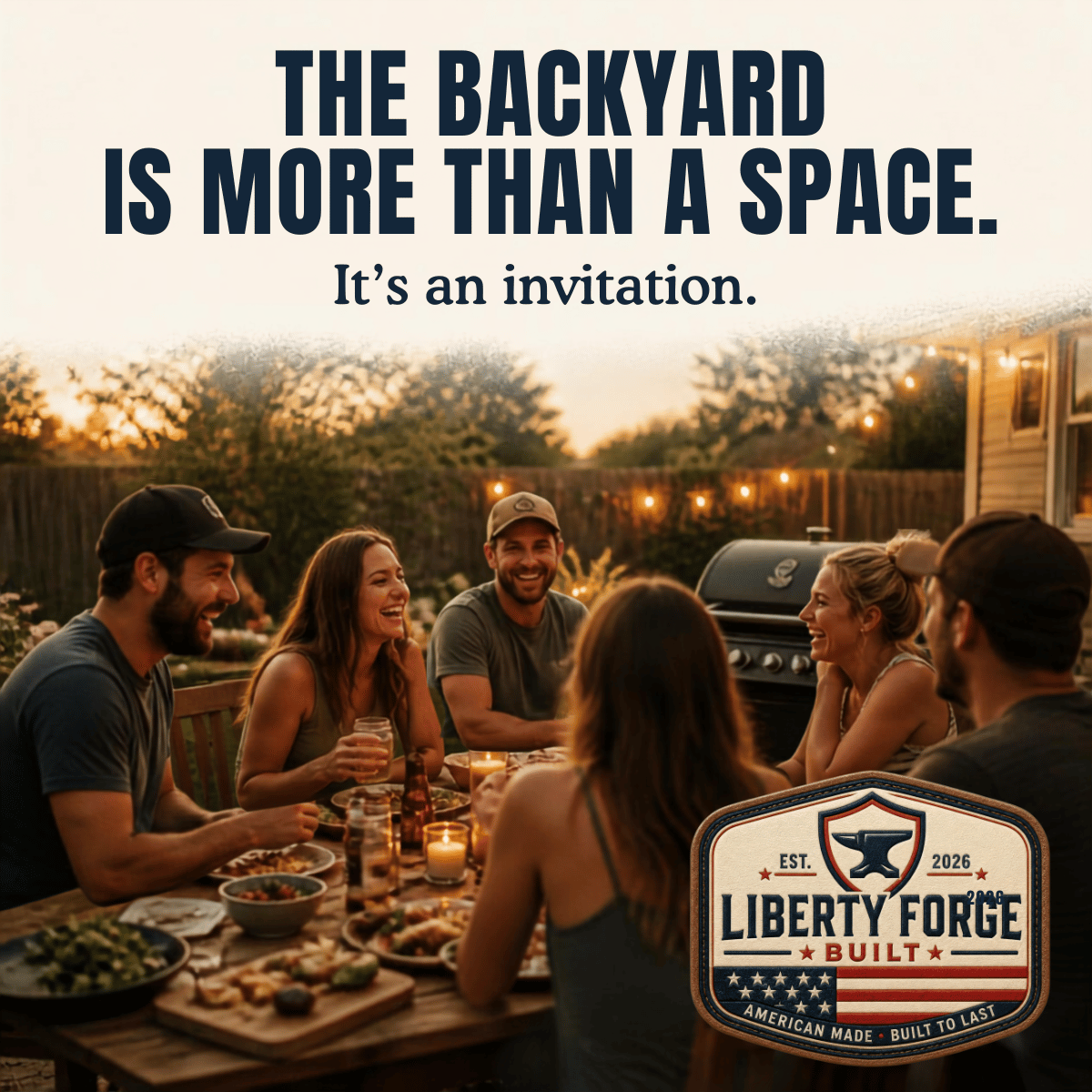
Friends laughing around a full backyard table at golden hour beside a grill and string lights, headlined "The backyard is more than a space. It's an invitation."

A backyard says something before anyone speaks.

An open gate. A few extra chairs already out. A cooler with the lid propped up. None of that is an accident, even when it looks like one. Somebody decided, on purpose or by habit, that this space was for other people and not just for the family that lives there. That decision is the whole idea. A backyard is not simply square footage behind a house. It is a standing offer.

Most of American social life has always leaned on spaces like this. Not banquet halls. Not restaurants booked weeks out. A patch of grass, a table, a grill, and whoever happens to be around. The tradition is modest by design, which is exactly why it has lasted.

What Actually Makes People Want to Stay

Hospitality is often talked about like a feeling, but a lot of it is just physical arrangement. A backyard either sets people up to talk to each other or it does not, and the difference usually comes down to a handful of practical choices.

Seating that faces in, not out, matters more than people think. Chairs lined up like a waiting room kill conversation before it starts. Pull them into a rough circle or cluster them around a table and strangers start finishing each other’s sentences within the hour.

Shade matters just as much. Nobody relaxes while squinting. A canopy, an umbrella, or just the smart placement of chairs under a tree gives people a reason to stay put instead of drifting inside where it is cooler.

Light after sunset keeps a gathering alive past the point most parties quietly end. String lights, a fire pit, even a couple of lanterns on the table signal that the evening is not over yet. Darkness has a way of nudging people toward their cars. Good light pushes back on that.

And a task people can help with does more for a gathering than almost anything else. Ask someone to man the grill for ten minutes, shuck the corn, or keep an eye on the cooler, and they stop being a guest standing around and start being part of the afternoon. People do not bond over being served. They bond over doing something small together.

The Standing Invitation, Not the Perfect Event

Somewhere along the way, hosting got confused with event planning. Matching decor, a theme, a timeline, an RSVP list managed like a wedding. All of that has its place, but it is not what built the backyard tradition, and it is not what keeps most families and neighborhoods actually connected.

The lower-stakes version works better for regular life: a standing invitation. Sunday afternoons, people know they can show up. No formal ask required, no obligation to bring anything fancy, no apology needed for showing up a little late or leaving a little early. The bar is low on purpose, and that is the whole point. A gathering that requires weeks of planning happens four times a year. A gathering that requires almost nothing happens all summer.

This is worth being deliberate about, not just hoping it happens naturally. Pick a day. Say it out loud to people. Keep doing it even on weeks when the yard is not perfect and the food is simple. Consistency does more work than production value ever will.

Cooking for a Crowd, Not Cooking to Impress

There is a real difference between cooking to impress and cooking for a crowd, and it shows up fast at a backyard gathering.

Cooking to impress is about the cook. It wants a reaction. It often requires precise timing, a small plate, and a bit of an audience. Cooking for a crowd is about the crowd. It wants everyone fed, nobody waiting too long, and the cook actually present instead of buried in the kitchen during the one part of the day meant for talking to people.

That usually means food that can hold. Things that stay good sitting out for a while. Things made in batches instead of single servings. Things that do not demand the cook’s full attention at the exact moment guests arrive. A big pot, a full grill, a folding table of sides works better for a real gathering than a single complicated dish that only one person can execute.

This is also where the host’s own state matters more than the menu. A relaxed host sets the tone for the entire yard. Guests take their cues from whoever is running the day. If the host is frazzled, checking the clock, and stressed about a scorched corner of a dish, that tension moves through the crowd whether anyone says anything or not. If the host is calm, unbothered by a burnt hot dog or a spilled drink, everyone else relaxes too. Simplicity is not a lesser version of hosting. It is often what makes good hosting possible at all.

The American Cookout, Briefly

The backyard cookout as most Americans know it grew up alongside the mid-twentieth-century suburban yard, the affordable home grill, and a culture that increasingly organized its social life around the weekend and the holiday. Grilling itself is older and wider than any one country, practiced in some form wherever people have cooked meat over open flame. What became distinctly American was the pairing of that fire with the backyard, the long weekend, and the informal guest list. Memorial Day, the Fourth of July, and Labor Day all became fixed points on the calendar where a grill and a yard did the same job a formal dinner did elsewhere: they gathered people and gave the day a shape.

None of that history requires getting dressed up or getting it exactly right. It requires showing up with the grill lit and the gate open.

Two or Three Things Worth Changing This Weekend

A backyard does not need a renovation to become an invitation. It needs a few decisions.

Arrange the seating so people face each other, not the yard. Set out a light source for after dark before you think you need it. Give the first guest who shows up early something small to do. And pick a standing day, even an imperfect one, instead of waiting for the ideal weekend to plan the perfect party.

None of that costs much. All of it is the difference between a backyard that sits empty most weekends and one that people quietly plan their week around.

Bring That Spirit Into the Yard

A backyard worth gathering in deserves the right gear for the person running it. Liberty Forge Built makes casual, comfortable apparel built for exactly these afternoons, from the Backyard Operations line to everyday pieces that hold up through a whole summer of cookouts.

For more on the traditions worth carrying forward, read Summer Is Happening Right Now.

For marketplace shopping, visit Liberty Forge Built on Etsy.

Posted on

Built for Those Who Answer the Call

Navy Liberty Forge Built graphic reading "Built for those who answer the call." above the anvil badge logo.

The phone rings at 3 a.m. and someone answers it.

That is the whole story, really. Before the fire truck rolls, before the cruiser turns on its lights, before the ambulance reaches the driveway, someone already answered. Someone was awake, at a desk, wearing a headset, ready for exactly this. The watch never ends, and someone is always on shift.

This is a story about the people who hold that shift. Military service members and veterans. Firefighters, career and volunteer. Police officers. EMS crews. And the 911 dispatchers who are first in the chain and last to be remembered for it.

The Voice Before the Vehicle

A 911 dispatcher’s job does not look like much from the outside. A headset. A bank of monitors. A chair that has held the same shape for years. But the job is not the equipment. The job is being the first voice a stranger hears on what might be the worst day of that stranger’s life, and staying steady enough, fast enough, and clear enough that the right help finds the right door.

Dispatchers work the radios and the phones at once, tracking units on the map while keeping a caller talking, breathing, moving toward safety if they can. They give instructions over the phone for things most people never have to do once in a lifetime. They do this shift after shift, call after call, without ever seeing the outcome in person. The fire crew gets the photo at the scene. The dispatcher gets the next call.

There is a persistent gap in how this work is counted. In many places, dispatchers are not formally classified as first responders, even though they are, by definition, the first point of contact. The apparatus rolls because the dispatcher sent it. The address is right because the dispatcher got it right under pressure. That gap between what the job actually is and how the job gets labeled is one of the quieter injustices in public safety work, and it is worth saying plainly: the first call deserves first recognition.

The Overnight Shift Nobody Sees

Every profession in this story shares a schedule problem that desk jobs do not have. Fires do not wait for daylight. Radio traffic does not pause for dinner. Somebody has to be there at 2 a.m., at 4 a.m., on the shift nobody wants and everybody depends on.

Ask anyone who has worked a graveyard shift in this line of work what it does to a normal week. Sleep happens sideways, in pieces, at hours that do not match the rest of the household. Meals get eaten standing up or not at all. The rhythms that most families take for granted, morning coffee together, dinner at a normal hour, get traded for a schedule set by a call volume nobody controls.

That trade is the quiet cost of the job. It is rarely the subject of the story, but it is the foundation underneath every story about a call answered well.

Holidays on the Clock

Thanksgiving does not close the dispatch center. Christmas morning does not empty the firehouse. New Year’s Eve, when most of the country is celebrating, is one of the busiest nights of the year for police, EMS, and the dispatchers routing them.

Volunteer fire departments carry a particularly heavy share of this. Across much of the country, especially in smaller towns and rural counties, volunteers make up a large share of the fire service. These are neighbors with day jobs who leave dinner on the table, leave a shift at their regular employer, or leave a kid’s recital when the pager goes off. They are not paid to be on call. They choose it, repeatedly, for years, because the town needs someone to answer and they decided it would be them.

Military families know a version of this too. Deployments do not check the calendar for birthdays or graduations. A parent or spouse in uniform might spend a holiday standing a watch on the other side of the world, and the family at home learns to celebrate around an absence, then close the gap again when the service member comes home.

The common thread across every one of these professions is continuity. Someone gives up the ordinary holiday so the ordinary holiday stays possible for everyone else.

What the Work Actually Asks

None of this is about glory, and it should never be framed that way. It is about steadiness. A dispatcher does not get to hang up because the call is hard. A volunteer firefighter does not get to skip the page because it is inconvenient. A police officer, an EMS provider, a service member overseas, none of them get to opt out of the parts of the job that are heavy.

What they get instead is a kind of quiet reliability that the rest of us build our lives on top of without thinking about it much. We assume someone will answer. We assume the truck will come. We assume the radio will connect. That assumption is not automatic. It is the product of thousands of ordinary people choosing, shift after shift, to be the one who answers.

That is worth naming clearly, without exaggeration and without turning it into spectacle. The people who do this work are not looking for a headline. Most of them would rather the story stayed quiet, because a quiet story usually means the call went well.

Carrying the Watch Forward

The idea behind Liberty Forge Built’s Watch Never Ends collection comes directly from this reality. It exists to recognize the full chain of people who answer, not just the ones who show up on camera. The flagship design in that line, The First Call, puts the dispatcher at the center on purpose, headset on, facing the monitors, because that is where the chain actually begins.

If this kind of story matters to you, it sits alongside the way we think about America 250 as a year-long story worth telling in pieces, not all at once. Service, like heritage, is easier to understand when you slow down and look at the specific people doing specific jobs.

Explore pieces made for the people who carry this kind of responsibility in the Everyday Patriot collection, or browse the full lineup at Liberty Forge Built. The marketplace shop is also open on Etsy.

The watch never ends. Somebody is on shift right now. It helps to remember that.

Posted on

Independence Is Not Seasonal

Navy Liberty Forge Built graphic reading "Independence is not seasonal." above the anvil badge logo, with the line "Freedom, service, grit, and heritage, year-round."

Independence does not end when the fireworks do.

It is easy to treat the Fourth of July as the whole point. The flags come out, the grill runs late, the sky lights up, and then it is over. The flags come down. The calendar moves on. But independence was never meant to live inside one day a year. It is not a decoration. It is a practice, and practice happens on ordinary Tuesdays, not just on the holiday that celebrates it.

The country was not built by a single vote or a single signature, as important as that document was. It was built, and it is still built, by people doing the unglamorous work of keeping a household, a trade, a fire company, or a town running. That work does not stop being independence just because there are no fireworks attached to it.

Independence Looks Like Skilled Work

Somebody has to know how to do things.

A person who can wire a panel, frame a wall, rebuild a transmission, or weld a broken gate hinge is not just useful. They are living independence in the most literal sense: the ability to solve a real problem without waiting for someone else to solve it for them. Skilled trades have always been part of the American story, from the blacksmith and the wheelwright to the electrician and the diesel mechanic working today.

Learning a trade takes years, apprenticeship, failure, and repetition. But it produces something that cannot be taken away: the confidence that when something breaks, you are not helpless in front of it. That confidence is independence with grease on its hands.

Independence Looks Like Maintaining What You Own

A country of owners has to know how to take care of what it owns.

Changing your own oil, sharpening your own mower blade, patching your own roof, or simply knowing where the water shutoff valve is in your house are not small things. They are the daily discipline of self-reliance. Every generation that came before learned to fix what it could before calling for help, and every tool passed down from a parent or grandparent carries a little of that lesson with it.

Maintenance is not glamorous. Nobody puts a caulk gun on a monument. But a nation of people who let things fall apart because fixing them feels like someone else’s job has quietly lost something. Independence shows up in the toolbox in the garage as much as it shows up in any founding document.

Independence Looks Like Showing Up for Your Neighbors

Volunteer fire departments and rescue squads are one of the clearest, least talked about expressions of independence in the country.

In thousands of towns, when the alarm sounds, it is not a distant agency that responds first. It is a neighbor who dropped what they were doing, put on turnout gear, and drove to help someone they may or may not know personally. Volunteer fire and rescue service has been part of American community life since before the country had a name for itself, and it still runs on the same basic idea: nobody is coming to save you but the people who live near you, so those people learn how to do the saving.

Mutual aid does not require a uniform. It looks like a neighbor plowing a driveway before the homeowner wakes up, a covered dish left on a porch after a rough week, or friends rebuilding a barn before the insurance check ever arrives. None of that needs a headline. It needs people who understand community is a set of actions repeated over years, not a feeling.

Independence Looks Like the Town Meeting

New England has kept a form of government running for centuries that puts independence directly in the hands of ordinary residents: the town meeting.

In many small towns across New England, citizens still gather once a year to debate and vote directly on their town’s budget, bylaws, and local decisions, rather than leaving every choice to elected representatives. It is slow. It is sometimes tedious. Anyone who wants to speak can usually get up and speak. That is not an efficient way to run a government by modern standards, and it was never meant to be efficient. It was meant to keep power close to the people who have to live with the results.

You do not need to live in New England to learn from that model. School boards, zoning boards, water districts, and town councils everywhere depend on the same basic principle: someone has to show up. Independence at the community level looks like sitting through a long meeting about a culvert, because the alternative is letting decisions get made by whoever bothers to attend, which is often nobody at all.

Independence Looks Like Raising the Next Generation

None of this transfers automatically. It has to be taught.

A child given a chore and expected to finish it is learning something larger than the chore itself. A teenager who works a summer job, saves toward something they want, and lives with the consequences of spending it too fast is building a habit that will outlast the job. A young person taught to shake a hand, keep a promise, and finish what they start is being handed the same inheritance every generation before them received, whether or not anyone used the word independence to describe it.

Responsibility is not inherited through blood. It is inherited through practice, modeled by parents, grandparents, coaches, and mentors who insist a job worth doing is worth doing right.

Independence Looks Like Running Your Own Shop

The corner shop, the family-run hardware store, the small contracting outfit with one truck and a handful of employees, these are independence made into a business plan.

Owning a small business means carrying the risk yourself. It means making payroll before you pay yourself, fixing your own problems on weekends, and standing behind your name because your name is the business. It is one of the oldest American stories there is, and it has never required permission from anyone to begin, only the willingness to try and the discipline to keep going after the first hard year.

The Other 364 Days

The Fourth of July will always deserve its place. It marks something worth marking, and it is right to celebrate it loudly.

But if independence only shows up one day a year, it was never really independence. It was a costume. The real thing looks like a volunteer firefighter’s boots by the back door, a toolbox that gets used, a neighbor who checks in without being asked, a town meeting nobody wants to sit through but everyone benefits from, and a kid who learns to finish what they start.

That is the story Liberty Forge Built exists to tell, the one explored further in America 250 Is a Year, Not a Day and in What We Pass Down Defines Us. Independence is not seasonal. It is a daily practice, carried by ordinary people who decide, every day, to show up for it.

Wear the Practice, Not Just the Holiday

If independence is something you live every day, it is worth carrying every day too.

Explore the Everyday Patriot collection for pieces built around that idea, or browse the full American Heritage lineup for designs rooted in service, craft, and community. You can also find the collection on Liberty Forge Built on Etsy.

The story continues, long after the fireworks end.